
Old is New Again
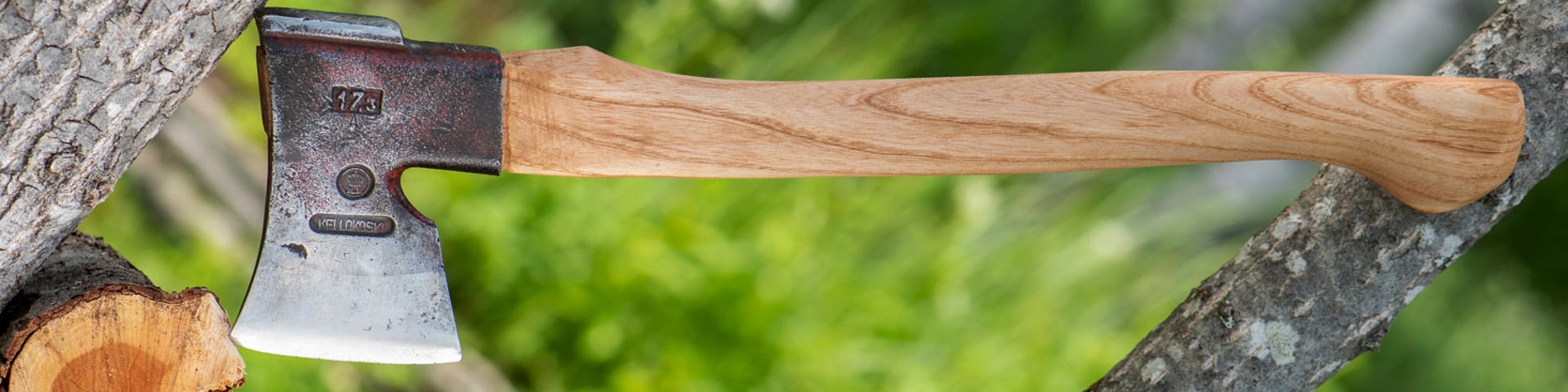
Restoration
Experience in the conservation and restoration of Finnish vintage axes and other tools.


Metal treatment
At first, a liquid rust remover is applied, followed by the use of a wire cup brush.
Surface-conditioning flap discs are then used for leveling and deburring. The cutting edges are not touched at this stage, although the blade geometry may be slightly corrected.
Next, the surface is prepared for polishing using sandpaper with grits of 60, 80, 120, 180 and 240.
Polishing is carried out with a felt flap polishing disc and a polishing compound.
Throughout the entire working process, the axe must not overheat. The temperature of the metal should be carefully controlled at all times. If the temperature becomes too high, the blade may be damaged and the axe can lose its quality.
It is also very important to follow all safety instructions.
For sharpening, a water-cooled sharpening wheel with a medium grit is used, followed by finishing on a leather belt.
Materials
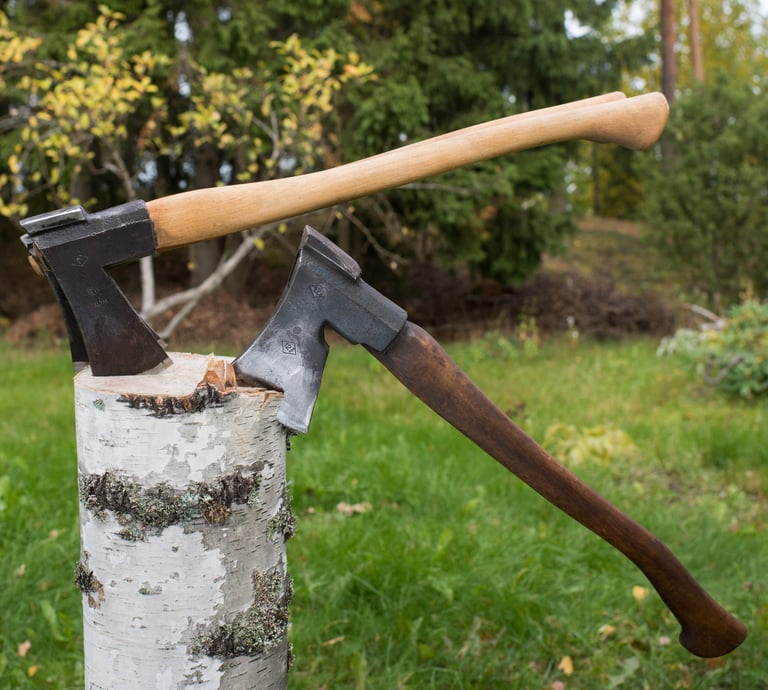
Birch is a traditional and typical wood used for making the handles of collared Finnish axes.
Obtaining suitable timber for axe handles has always been an important question. One traditional method of improving wood quality was to remove the bark from one side of a living birch tree. The exposed side gradually became more durable, darker, and heavier. This process took approximately 15–25 years.
Previous generations planned far ahead to ensure that their sons would one day have proper timber for axe handles.
Axe handles made from hickory became available in Finland after World War II. However, people soon noticed that hickory felt harder in the hands, was less flexible than birch, and transmitted more vibration. In addition, hickory axe handles tended to split along the grain during very low winter temperatures.